On Rewriting the Rules of Life with Amie McNee: A Written Q&A
I’ve followed Amie McNee since 2022. Back then, I was recently married, recently laid off, and newly committed to following a more creative path in my life and work. It was exciting; it was terrifying. But I found reassurance on the pages of my journal and in Amie’s words.
Four years later, I still do.
When I feel lost in my creative journey, Amie’s words are a beacon. When I feel misunderstood, they remind me I’m not alone. And when I feel trapped by the rules of life (real or perceived), Amie’s words remind me that I have the ability to rewrite them in ink on the page.
That’s what this Q&A is really about: rewriting the rules of life. More specifically, it’s about how Amie uses journaling to invoke change in her life and show up better—for herself, her relationships, and her art.
I hope her story inspires you to pick up the pen and do the same.
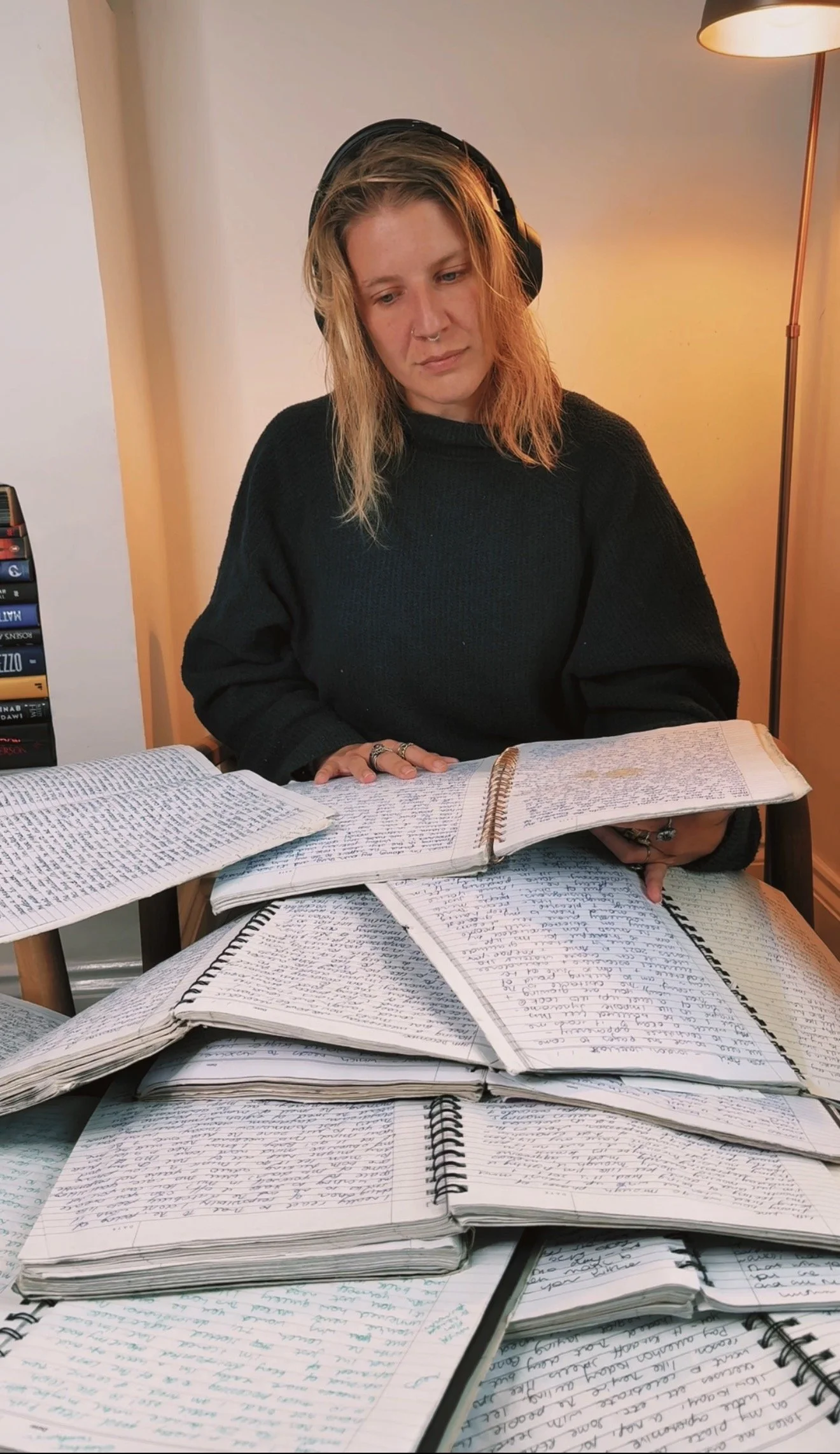
You started journaling in 2018. What made you decide to start then, specifically?
A dear friend had gifted me The Artist’s Way maybe a year or two beforehand, it had sat on a shelf untouched all that time. But on April 16, 2018, I had lost my job, I was in huge amounts of credit card debt, my books were being rejected by every agent in the world (it felt), and I was feeling incredibly hopeless. I knew my approach to life wasn’t working. I told myself, “You need to do one positive thing a day,” and so I decided it would be journaling. I went to my local cafe, bought a coffee on the credit card, and I did my first ever “morning pages,” as Julia Cameron calls them—and I haven’t stopped since.
Had you ever tried journaling before that moment?
I have journaled/kept a diary since I was 6 or 7. I have always wanted to put the inside things onto an outside thing. I think it was often a way for me to feel control, or to clarify the emotions I was experiencing. It was also a way for me to define myself, especially in my teenage years, a way of declaring who I was. But it was never consistent, not until I was 26 years old.
A lot has changed in your life since then, especially in terms of your creative success. How has your journaling practice evolved to accommodate your life now?
My journaling practice is why my life is entirely different and entirely delightful now. I had so many stories about who I was and what the world expected of me, and the way I re-wrote those stories was through journaling. My practice allows me to re-write the rules of life. It has allowed me to re-write the way I behave, speak to myself, show up. It has felt, quite literally, like a magic wand. When I want change, I must use my pen and write about it.
Journaling has a way of introducing us to parts of ourselves we didn’t know before. What’s the most surprising thing you’ve learned about yourself on the page?
This is a beautiful question, Dylan. I think, funnily enough, that I am capable of great internal change. I didn’t realise I was so malleable. I thought who I was—the neural pathways that were so well-trodden—was who I would be forever. But I am so changeable, I am able to create new stories, new ways of behaving, new beliefs. It amazes me to this day.
Journaling is also good for showing us what’s not working in our lives. What’s the hardest truth you’ve uncovered about yourself while journaling?
Ah yes, I discover the harder things regularly, too. A good way to discover the hardest truths through journaling is this horrifying prompt: What are you not willing to write about? I try to come back to that question semi-regularly. It keeps me honest. Because the journaling practice is not useful if it is not honest. I see all my darkness and all my light on the page. I try to meet the darkness with compassion, but it can be hard and confronting. Most recently, my journaling revealed to me just how difficult I am to be around when I am dysregulated, which honestly, is a lot of the time. I am working really hard to be more aware of how I impact people, especially my partner, when I am over stimulated, or even just overexcited. I have big emotions, and they don’t just affect me.
How do you feel your journaling practice has influenced the way you show up in the world/your relationships? Is there a specific moment you can think of when you acted differently because of your work on the page?
I am so much more sure of myself. Because I know who I am. And I know who I am because I convene with myself each morning on the page. It means that when a boundary is crossed, or I am misunderstood or treated badly, I have the ability to navigate it. It has allowed me to be so courageous and brave because I know I can withstand rejection and failure. It allows me to be bold because I back myself. The other day I turned down an opportunity that I would have fallen over my feet for in 2018. I declined it because it was not right for me, and it did not serve me, even though it came with a huge amount of prestige. I would never have had the courage to do that before journaling.
Rewriting our stories can be a long, slow process. What’s one story you’re still working on rewriting? What’s one from your early days of journaling that never comes up for you anymore?
This is something that many of us forget. It takes years and years. My issues with resting and believing I was worthy of rest were a huge problem—I thought I would never get over them. If you read the first three or four years of my journals, you will see the same stories over and over again. “I feel like a piece of shit, I haven’t done enough” responded to with my rewritten stories: “Amie, darling, this is the culture, not your soul speaking. You do not need to be productive to earn quiet and peace. You do not need to race through life, your slowness is holy.” I genuinely thought I would re-write that neural pathway—but guess what? I really don’t have an issue with this anymore. But it did take years and years of re-writing. My current story rework focuses heavily on regulation and irritability. There is a story I am re-working that says, “That’s just the way I am.” But as I said before, I am so malleable. I can become whoever I want to become.
You’ve mentioned seeing a therapist before. How has therapy informed your journaling practice, and vice versa?
I have seen therapists on and off since my early twenties. For me, therapy is needed when I truly require an outsider to offer their perspective or simply to act as a witness. I am someone who really needs to be SEEN and understood, especially when I am in pain. It can also help when I am stuck in a very closed loop of thought and I need someone on the outside to come help me break the cycle. Then, I continue that journey in my journals.
You’ve talked before about your Mothering Voice. What other voices regularly come up in your journaling, and how does your Mothering voice respond to them?
I had a big think about this, Dylan, and even had a little browse through my journals. I see different parts of me on the page: the teenager, the tiny child, the victim, the ambitious mother fucker who wants everyone to get out of her way—but the higher voice, the response always seems to come through this voice that I have named the Mothering Voice. Initially, this voice appeared to me on the pages of my journal as my Defender. I was so cruel to myself, I had a lot of self-hatred, and she put a firm but loving stop to those narratives. She was my protector. But she has morphed over time as I have changed. Lately, she is the voice that says: “I see you, you are a visionary, and you are inevitable, but you cannot control everything, nor can you do it all at once.” She reminds me to trust my journey, and to loosen my tight grip on the reins. She is all-knowing and she is magnificent.
There’s a lot of journaling advice out there. What’s one piece of advice you completely disagree with, and one you wish everyone knew about?
My advice I disagree with is, controversially, the three-page morning pages rule. I owe Julia Cameron a lot, she is the reason why I started this practice. But writing three pages of journaling each day is too much, and it stops so many people from even trying. I do half a page to a page and it is life-changing.
What’s your biggest piece of encouragement to someone new to journaling? And to someone further along who’s thinking about giving up their practice?
My encouragement would be: Let yourself put your darkest, hardest thoughts on the page—but always finish by countering those narratives, even if it feels false or silly. So many people find journaling only sinks them deeper into their negative self-talk or anxiety. It becomes a place that re-enforces the darkness. A place to stew. The magic comes when you challenge yourself, when you defend yourself, when you re-create yourself on the pages.
About Amie
Amie McNee is a Creativity Coach, Writer, Podcaster, and Author behind the creative revolution “Inspired To Write.” Visit her website to learn more (and buy her books!!).
Want more like this? Subscribe to get my words and work delivered to your email.