How Journaling Changed My Self-Image As a Writer
I recently had the pleasure of writing a guest essay about my journaling practice for Elizabeth Aman’s Substack. (Thanks, Elizabeth!) In it, I share a few of the ways journaling has changed how I see myself as a writer, including - ahem - seeing myself as writer in the first place.
The essay went live over the weekend while I was hiking with a friend in Montana . . .

. . . but I’m back in Brooklyn now and excited to share it with you.
You can find it riiight here.
Or, just scroll down—I’ve pasted the essay in full below.
If you’re curious about using journaling to positively shape your identity as a writer, you’ll definitely want to check it out.
How Journaling Changed My Self-Image As a Writer
If you had asked me five years ago if I was a writer, I would have said no.
I wouldn’t have told you about the poem I had published in high school. I wouldn’t have told you about the short story I wrote in my college creative writing class about coming out, or how I still kept it (along with my professor’s notes on how to improve it) in a yellow folder in a box in my closet. I wouldn’t have told you how any time I read a great book I thought, I wish I could write like that.
Instead, I would have completely denied my identity as a writer because—despite all evidence to the contrary—I didn’t know I was one. Yes, I liked writing. There were even times I thought I was pretty good at it. (A former boss of mine once told me I wrote “the best emails,” and I rode that high for years.) But the idea that I was or could be a Real Writer had never really occurred to me.
Until I started journaling in 2022.
My only goal back then was to fill three pages every morning. According to Julia Cameron in The Artist’s Way, that’s how much I needed to write to access my inner artist and spark creative change in my life. I didn’t understand exactly how that would happen, but I was willing to try. So I did. Doubts, dreams, frustrations, ideas, whatever random words bubbled up in my mind—I wrote them all down on the page. I did this day after day after day. And gradually, things started to change. I started to change.
Here are a few of the ways journaling transformed my self-image as a writer:
I started identifying as a writer.
If a writer is someone who writes, and I show up every day to write in my journal, then I am by definition a writer. It doesn’t matter what or how or how much I write. It doesn’t matter if my words are published or read or shared with anyone beyond myself. The more I wrote in my journal, the truer this piece of my identity felt. I became a writer who writes.
I got better at caring for my inner critic.
My early journals are filled with lies like “This is so stupid” and “You’re wasting time.” I wrote down every mean thing my inner critic said to me until I eventually realized it wasn’t trying to be mean at all. It was just scared. So I started responding to its fears on the page. I asked questions, offered reassurance, and comforted it the way a loving parent soothes a small child. The more I wrote like this in my journal, the more trust I built with my inner critic. I became a writer who could write through fear without wrecking the small, scared parts of myself.
I got more comfortable with imperfection.
“Messing up” was one of my biggest fears when I started journaling. I was afraid to write about the wrong thing or misspell a word or describe something incorrectly. I was also afraid of being inconsistent in my handwriting, ink color, and formatting. At some point, I decided to prove to my inner critic it was safe to “mess up” by intentionally messing up my journals. I wrote upside-down and in the margins. I misspelled words on purpose and did not fix them. I even painted over some of my journal entries. The more I “messed up” writing in my journal, the less scary the consequences became. I became a writer who keeps writing even when it’s imperfect—and I’ve written more than I ever would have because of it.
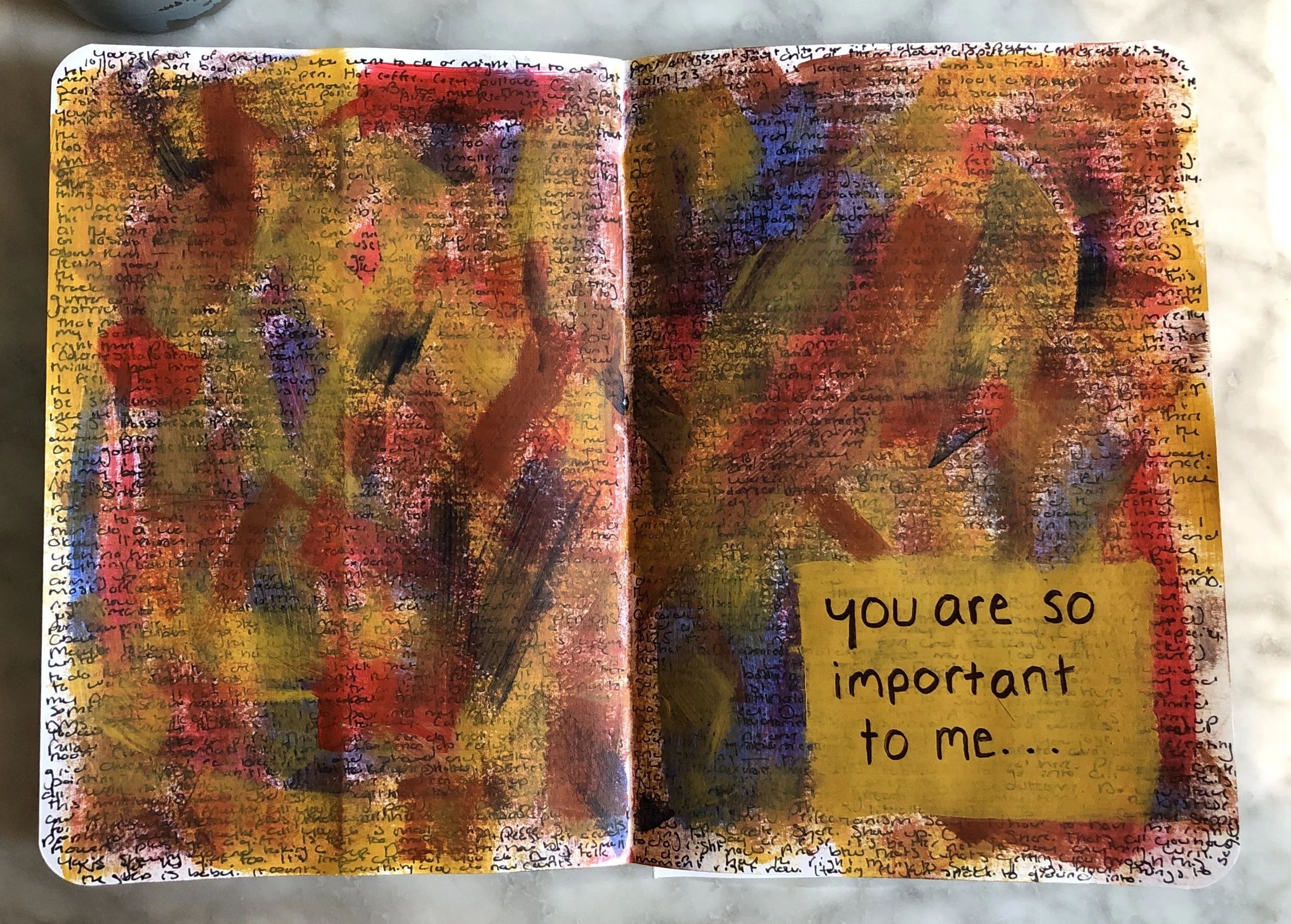
I became more confident—in myself and my writing path.
When I started journaling, I didn’t know where it would lead. I just kept writing, noticing my ideas, acknowledging my doubts around them, and encouraging myself to be brave. Somewhere along the way that practice led to sharing my thoughts about writing and journaling with my email list (now Substack), writing marketing copy for companies and brands, and writing more of my own short stories, essays, poems, and book ideas. The more I wrote about my ideas in my journal, the more small steps I discovered I could take to make them a reality. The more small steps I took without dying, the more my confidence grew. I became a writer who takes bold action in the direction of my curiosity and trusts that every step is leading somewhere worth being.
Five years ago, I would’ve told you I wasn’t a writer because I didn’t believe I was one.
It took getting to know myself—my fears, hopes, and dreams as well as how I like to be cared for, encouraged, and motivated—to start to transform that self, and for me, the page was the perfect place for that transformation to take place. It still is. Though I don’t journal every day anymore, journaling is and will always be one of the most important tools I have for acknowledging, navigating, and comforting myself through the ups and downs of my writing life—a journey I plan to be on for the rest of my life.
Because I am a writer. I have always been a writer. I will always be a writer.
And the best part is I actually believe it.
Want more like this? Subscribe to get my words delivered to your email.